
Fragrance Design with Naturals
Since publishing this, a couple of articles of interest have come to my attention, relevant to the use of naturals and the regulation by the scent manufacturers:
Washington Post, 2021 - Perfumer Makers Sniff at New Safety Regulations
Fragranitica - Thought piece by Mandy After, leader in natural perfumery, “The Funky Smell of Overregulation”
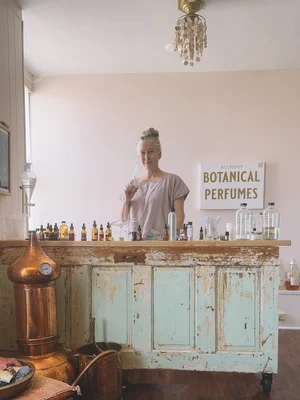
The goal of a perfumer is to create a harmonious and intriguing fragrance. Natural, or botanical, perfumers use only materials that grow and can be harvested. While commercial ventures use mostly lab-synthesized materials.
There is the assumption that the natural perfumer must be limited. Instead we find infinite variability because plant essences take on the character of their environment, which is expressed in the aromatic profile. Vetiver from Haiti has subtle aromatic differences from the vetiver harvested from Indonesia - and even comparing harvests from year to year in one locale will offer interesting contrasts.
The method of extraction also matters to the fragrance. A steam distilled essential oil has different aromatic aspects than an absolute. And the color can even vary. For example, lavender angustifolia essential oil is clear - slightly yellow in color, sharp, medicinal, green and herbaceous. But the absolute of lavender angustifolia is nearly opaque, blue ish, gentler, and more floral than herby.
One of my favorite new offers is Cypria, a fragrance designed in the classic chypre class of perfumes. Chypre (sheep ra) are an olfactory group with clean, sharp, bright citrus and florals in harmony with oak moss, labdanum, patchouli and bergamot. Read chypre.
IS IT PERFUME OR AROMATHERAPY?
A Perfumer is concerned with creating an intriguing, balanced and pleasing fragrance. And the Aromatherapist is concerned with wellness.
Aromatherapists typically use the steam extracted Essential Oils which are produced in the leaves, barks, roots and stems of plants.
The Perfumer is not limited to method of extraction and can choose based on the aroma profile, not the medicinal capacity of the plant.
The Natural Perfumer is concerned with the chemical interplay of the essence in the bottle, in the air and on the skin, and with the aromatic story the resultant fragrance will tell.
Both the perfumer and the therapist have a responsibility to know their materials: everything that goes on the skin will be absorbed by the body and the end user must be safe.
NATURAL CAN BE DANGEROUS - AND NOT ALL SYNTHETICS ARE BAD
Just because a substance occurs naturally, it is not necessarily safe or desirable: Bitter Almond and Hemlock are 'natural' but can cause adverse reactions or death.
Synthesized fragrances do allow the perfumer (or scent scientist who formulates the detergent fragrance) to create a consistent blend because the ingredients are identical from batch to batch. But manufactured musk molecules from our laundry detergent are not very biodegradable - and end up in our blood stream (and in fish).
In some cases the use of synthetics is desirable when countered by the over-harvesting of the natural aromatics; rosewood for example (we use Nature Identical). Or when crops fail for several years in a row and natural vanilla extracts become cost prohibitive it’s helpful to note that the chemical responsible for the scent of vanilla, vanillin, can be synthesized from cow dung. That aroma profile is key to creating amber accords.
Not to confuse things further, but the idea of ‘nature identical’ or naturally derived molecules offer depth to fragrances that are often challenging to achieve with only essences distilled outside a lab.
The alchemy of transforming separate elements into a new sophisticated fragrance is magical and scientific, and infinitely variable.
PERFUME AS LUXURY
Perfumery and luxury have long been paired - in the very beginning the raw materials for the creation of fragrances, namely spices were aspirational.
When utility was paramount to your survival, luxury was of very little concern. Creature comforts were a step above mere survival. And throughout history access to the necessary materials had way more challenges. For example, fresh ginger once had the same value as one sheep, or peppercorns are counted one by one as currency, the allure of spices is their luxury, not necessity.
Luxuries by their definition are not needs, but because we are creatures of desire, luxuries are necessities.
For a time luxury came to be associated with ‘expensive’. In a recent survey of followers, a few key words came up repeatedly: time, comfort and beauty. Wants, not needs
Perfume is the very definition of a luxury: and it feeds the spirit and the mind's quest for beauty.
INDULGE
Often when we are presented with scent, we inhale deeply and make a quick judgment: Like / Dislike. I encourage you to approach this a little differently. I’ve attached a document that will help you appreciate the scent-exploration process more fully ‘How to Smell’.
When fragrances are evaluated by professionals, they spritz on the tester and let it evaporate for a few seconds before wafting the aroma a little ways away from the nose. Taking a moment to take an impression instead of like / dislike: What am I smelling, experiencing, feeling - -what words come to mind? Instead of thinking: I smell citrus. Maybe ask is it sharp, warm, wet, or cool. Does it have texture? Does it trigger a memory.
Further reading:
Mandy Aftel, The Essence & Alchemy, and Fragrant
Steffen Archander, Perfume and Flavor Materials of Natural Origin
Justine Crane, Working the Bench II: A Practical Guide for the Apprentice Natural Perfumer (lots of information on naturally derived essences)

Alchemy, LLC 2020-2023
Want to dig a little deeper? Recommended reading.
(These are just the books I actually own and have read… there are many, many more)